27 July, 2025
What do you do when you essentially get a two-day hall pass to explore your favorite part of your home state?
In my case, you squeeze every experience out of it that you’ve imagined, right up until you nearly get the shit scared out of you.
And then you slink back to town for some tacos.

In August of 2011, my wife Cristina’s parents invited the four of us, along with her then-bachelor brother Bill, for a week-long adventure at Isle Royale National Park. When you look at the map, Isle Royale is the large island on the northwest end of Lake Superior – the scowling eye of the wolf’s head, so to speak. Technically, Isle Royale belongs to Michigan, but the island is visible only from Minnesota and Ontario. No one would look at a map and say, “Yep, that’s totally Michigan,” although we did come to find out it’s a geological twin of the Keweenaw Peninsula in the U.P.
For our crew, this trip was a timely adventure. On one end of the spectrum, our kids were 8 and 5 years old: Perfect ages to both introduce them to wilderness hiking while also managing the day-long ferry trip from Grand Portage, Minnesota without going bonkers. On the other end, my in-laws were crossing into their 70s, getting on in years but still able to put on a pair of boots and hike some miles themselves.
Most visitors to Isle Royale are the tent-and-trek types. (The island is too far from the mainland for most day trips.) We, on the other hand, would not be roughing it quite so much. We declined the tents for something a bit more deluxe, relatively speaking – staying at Isle Royale’s only formal lodging: a small, comfortable place at the eastern end of the island called Rock Harbor Lodge.
Our first few days on the island went splendidly. We hiked out to Scoville Point, the eastern end of the peninsula, and took in the panoramic lakeside views. We rented a small boat and puttered across the harbor to visit an abandoned lighthouse. We visited researcher Rolf Peterson’s secluded house and explored its backyard, an absolute riot of moose antlers and wolf skulls. And we got very well acquainted with the rangers at Park Headquarters who appreciated our bringing two young kids to Isle Royale, usually not a kid-oriented place but instead the domain of crunchier veteran backpackers. (One of these rangers led an evening seminar on the geologic history of the island, and he invited five-year-old Maren to act out an erupting underwater volcano. It made for effective instruction: That was one lesson I will never, ever forget.)
By the fourth day of the trip, however, my left ankle was talking to me. Barking, really. Shortly before we left home, I began noticing a dull pain in my foot, accompanied by an increasingly visible redness. It looked like a sunburn, and it felt like minor sprain. Each day of the trip, the pain grew progressively more intense and the redness climbed another few centimeters up my leg. By midweek, the issue had risen halfway up my calf.
We were scheduled to take a boat ride that morning to a trailhead leading to a scenic hilltop viewpoint called Lookout Louise. From there, Cristina and Bill would head off on a 10-mile brother/sister hike back to Rock Harbor while their parents, the kids, and I returned via the boat.
From the trailhead, I was fine to limp to the top of the hill. As we took in the sights from Lookout Louise, I let Cristina know I hoped to get my ankle checked out as soon as we got back to town. (“Town” being perhaps a stretch here. Boasting just a lodge, a restaurant, the park offices, and a small harbor, “settlement” paints a more accurate picture.) With a quick kiss, I wished her well on her hike, and she wished me well in finding whatever medical attention was available on this proudly isolated island.
I would not see her again for three days.

Upon our return to Rock Harbor, I headed straight to the park office without even stopping by our lodge accommodations. There, I was impressed to learn that in the absence of a formal clinic on the island, the rangers themselves were trained to serve as front-line medical staff. This was a bit like finding out your local landscaper moonlighted as a cybersecurity consultant. The ranger who received me – who of course recognized me from several previous meetups that week – gave my leg a once-over and said, “My guess is it’s cellulitis, but I’ll need to call the hospital to make sure.” He picked up the phone and dialed the hospital in Houghton, Michigan (the mainland home base of this distant national park). Sure enough, the emergency room doctor there heard the ranger’s description of my condition and confirmed the diagnosis. And then I heard the doctor say something that nearly knocked me off my chair: “You need to get this patient off the island immediately.”
Whoa, what? Did I hear that correctly? We still had three more days of exploring Isle Royale. Surely this could wait until we all left on the ferry, right?
The ranger said no. “This is a serious condition,” he informed me. “It’s a bacterial infection – a poisoning, essentially – and it could be life-threatening if it’s not treated right away. And what treatment usually involves is a three-day course of penicillin shots.” Because our car was still parked in Grand Portage, he said he would call ahead to the hospital in the larger town of Grand Marais to let them know I was coming.
The ranger then arranged for me my very own boat escort back to the mainland, courtesy of the National Park Service. For a moment there, I felt rather proud of the federal tax dollars I’d paid that year. He gave me 30 minutes to return to the lodge, explain this bizarre situation to my in-laws, and pack my bags.
Guess who I didn’t have the opportunity to explain it to?
At this point, Cristina and Bill were still just a few miles into their day-long hike. Cell reception was nonexistent, and there was nothing she could have done to change plans anyway. I was minutes from leaving the island, a medical fugitive, leaving her to manage family matters there without me for three more days.
The usual ferry to and from Minnesota was a ploddingly slow passenger boat called the Voyageur II. The Voyageur II could make only one circumnavigation of the island back to Grand Portage every two days. Even if Cristina could have rescheduled their trip back on the ferry, it wasn’t making the return trip until the following day – and, to no one’s surprise, the next day’s boat was full. The last message I left with her parents was that I would meet her and the kids in Grand Portage at our scheduled arrival time three days later.
Back at the dock in Rock Harbor, I met the two park rangers who would be my chauffeurs back to the mainland. My trip would not take place in a comfort cruiser but rather in a small, aluminum, NPS-issue powerboat. This voyage took four long hours, and the Lake Superior waters were a whole lot choppier than anticipated. The boat lurched up and down for nearly the entire trip. Each time it loudly slammed into another wave, I marveled at the quality of the rivet welds. Due to the pace of the morning developments I’d missed lunch that day, which turned out to be a good thing because it likely would have wound up on the floor of the boat.
When we finally arrived in Grand Portage, I wasted little time saying goodbye to the crew. Eager to put that fierce passage behind me, I limped across the parking lot to our car and drove 20 scenic miles south to the Grand Marais hospital. The staff admitted me right away, examined my angry ankle, and administered the first of my three shots. I would need to return the following day, and again the day after that.
And then, for the next two days, it was nothing but me time in Minnesota’s Arrowhead.

Family finances were tight that summer, so I would not be luxuriating in a harborside hotel. Instead, I drove 10 miles north of town to Judge C.R. Magney State Park and pitched a tent (a fortunate possession at the time, thanks to our camping there the night before stepping onto the boat). The book I’d been reading on the island, Haruki Murukami’s The Wind-Up Bird Chronicle, became my only companion for the next couple days.
And other than the requisite 20-minute visit to the hospital each day, I was free and clear to spend my time however I wished. It all felt incredibly liberating, much like extending a business trip because the airfare was already covered. How did I spend my time? Well, first off I headed back to Grand Portage and visited the historical National Monument there. I strode along the beach in Grand Marais and wandered the grounds of the regionally famous North House Folk School. I drove to the end of the Gunflint Trail, a 2½-hour round trip through dense forest into the Boundary Waters wilderness.
On Day 2, with all the time and barely a care in the world, I decided to tackle one last solo adventure. For years, we’d driven past a high, exposed promontory called Carlton Peak on our frequent visits to the North Shore, peering up at the 600-foot monolith of the Sawtooth Mountains and wondering what the view would look like. Today I would find out. My ankle had started responding to the antibiotic, and I was frankly a bit restless to get away from the car.
The trail to the top of Carlton Peak is located on the Superior Hiking Trail, a 280-mile trek from Duluth to the Canadian Border. Because of this, it boasts a trailhead with ample parking, the trail is well established, and the signage and markers are second to none. I set off up the trail carrying nothing but my keys and my iPod – prime 2011 tech.
The weather was overcast, the temperature pleasant. The hike itself is not long – a distance of less than two miles from the parking lot – and the first half-mile is generally flat, crossing a marshy area via a series of boardwalks. The trail then heads uphill, getting truly steep only for the final stretch above the treeline. Hikers must scramble around a couple large boulders before arriving triumphantly at the top.
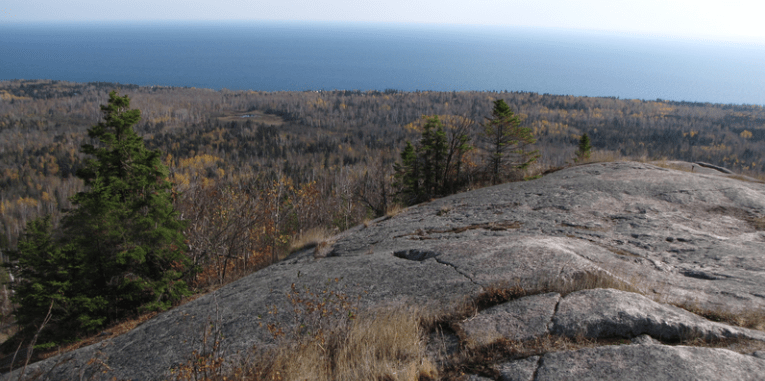
From there, I looked out over the vista. The view was worth every hobbled step. Even with the cloudy conditions, I could see well across Lake Superior to northern Wisconsin. The mountain dropped off sharply to the south, exposing a wide-open view of the forested valley below. At that moment, the winds began picking up ominously, sending the trees beneath me into wild undulations. I capitalized on this drama by firing up my iPod and listening to Mussorgsky’s A Night on Bald Mountain – a perfect marriage of music and moment.
Given the conditions, I stayed just long enough – 15 minutes or so – before starting back down the trail. If the weather grew any more extreme, this bare outcropping nearly 1,000 feet above the lake surface wasn’t the wisest place to be.
The first mile downhill went briskly by. Then, shortly after the trail flattened out again and ducked below the canopy, I was briefly startled by a rustling to my right.
I stopped for an instant. The first thing I saw poking from the brush was a big, black nose. For a moment, it looked like it might belong to a very large German Shepherd. Then the rest of this beast appeared…and it was none other than an adult black bear. What’s more, tagging right alongside this big bear were a couple baby bears. I’d bumped into a mama bear! And these three bears were no more than 20 feet from my goldilocks and my suddenly frozen ass.
Well, this is it, I thought as my hair stood on end. Most people wonder how they might eventually depart this earth. My fate was to become mama-bear mincemeat. Making matters worse, nobody knew I was here. I’m sort of not sure how I didn’t destroy my shorts at that very moment, though the emptiness of my budget-bound belly may have had something to do with it.
I instantly thought back to lessons about how to deal with a bear encounter. Minnesota is not home to more ferocious bears like grizzlies or Kodiaks; climate change has not yet pushed their migration southeastward. In the case of black bears, your best bet is not to run, but to stand your ground and “get big.” Black bears don’t appreciate a good startle any more than the rest of us, but they’re mostly out looking for berries and human food – not humans themselves.
So in that split-second, I “got big.” What else could I do? I raised my arms to tower over this bundle of fearsome fur. (No German shepherd she, the bear probably did weigh 2-3 times my bulk.)
To my literally undying relief, she took one last look at me, assessed her options, gave a quick grunt…and turned back into the woods, cubs trailing close behind. I listened as their steps through the trees faded off, and then I hauled my very same ass down to the parking lot.
Time to turn in my hall pass. My adventures were over. I’d gotten a couple freebie days in the Arrowhead region, and I made them count. But I couldn’t take any more risks with my family traveling back on the Voyageur II the next day and no way to contact them.
I quietly drove back to Grand Marais and found a seat at Hughie’s Taco House (now reopened as the Hungry Hippie). The three tacos I ate that night went down like communion wafers, full of grace and rebirth. Then I made my way back to my tent at the state park campground, where for the rest of my time I would encounter nothing more wild and crazy than the wandering prose of Haruki Murukami.
© Erik Lien
 Erik Lien
Share your thoughts